I played Seven-Part Pact and was consumed by Wizard Madness
This was written as a submission to the Knowledge Knight review jam held by the Quinns Quest community on discord.
 Image description: Official Seven-Part Pact artwork by Pam Wishbone, depicting a triptych with a wizard on the central panel, a port on the left, and a tower on the right.
Part 1: Wizards Are Mighty
There’s a phenomenon among fans of Jay Dragon’s upcoming TTRPG Seven-Part Pact that they call “Wizard Madness”. They say that should you play it, or even just read the rulebooks, you’ll quickly become obsessed with wizards. You’ll write about wizards, draw wizards, tell everyone you know about the wizards. Wizards will even begin invading your dreams.
I signed up to a one shot of Seven-Part Pact’s latest playtest draft full of wizardly arrogance. Wizard Madness? I’m a sci-fi fan, there’s no way I’ll become obsessed with wizards! Oh what a fool I was, for before the game even started Wizard Madness had already gotten its claws into my prefrontal cortex. And now I fear it may never leave.
In the archipelago of Isha, across the Faraway Sea, the Seven-Part Pact is an alliance of seven incredibly powerful wizards keeping magic in order, centuries after a series of catastrophic wars between wizard-kings almost brought their world to an end. Each of the seven wizards has their own domain, carrying with it their own magic, their own companions, and their own personal responsibilities.
These wizards range from the Necromancer, a grim psychopomp guiding souls of the dead through the Gates of the afterlife and trying to keep vengeful undead from reaching the surface, to the Mariner, a hardened sailor-druid keeping trade routes clear, dealing with storms, and vanquishing magical beasts threatening the archipelago, to the Sage, an ephemeral hermit predicting and guiding the future of the Pact.1
I would be playing the Warlock, a battlemage-in-peacetime playing with court politics and keeping authority in the King’s hands.
Part 2: Wizards Are Men
Seven-Part Pact has really fucking good character creation. I started making my character with a bit of trepidation, unsure if I could stand out alongside six other wizards rather than fall into the background.2 I left with a character who could’ve been the protagonist of a five book saga of fantasy novels.
Character creation, conducted both on your character sheet and within your own personal codex, takes the form of a series of questions. The initial questions flesh out your character’s personality and history with a series of scenarios, noting down how your character would react and distributing your ability scores (the four classical elements) based on those responses. These questions are great, not only because they’re evocative and immersive, but also because they establish truths about the setting and your character’s role in it. The Warlock is always of noble blood, but is he beloved by his family or is he the black sheep? He’s fought in battle before, but does he see himself as a hero or an executioner? He stands at the King’s right hand, but is he more loyal to him or to the Pact?
As character creation continues you also get to give your character some cool treasures, a familiar, and some wonderfully weird transformations from their prolonged exposure to magic, then flesh them out even further with their own supporting cast(!) of four companions who take care of different aspects of their life. And then, to cap it all off, you get to draw locations onto the map of the island that your wizard is based on.
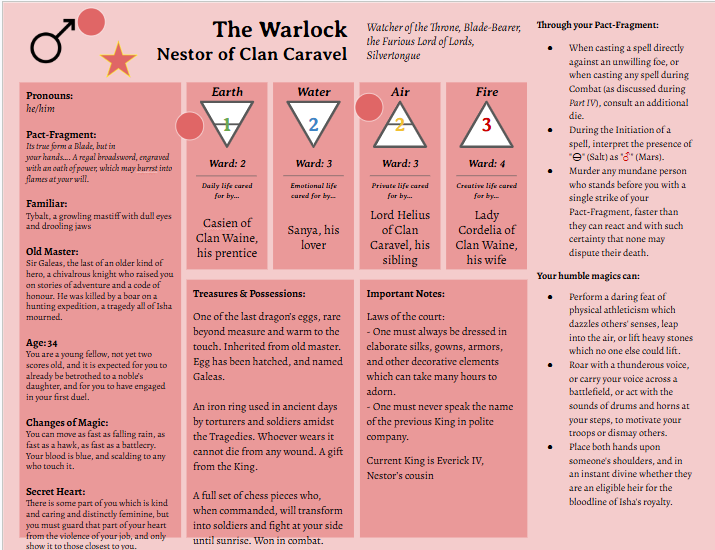 Image description: A completed Seven-Part Pact character sheet for the Warlock Nestor of Clan Caravel.
It is so, so easy to get excited after this character creation process, and after making my Warlock (Lord Nestor of Clan Caravel, Watcher of the Throne, Blade-Bearer, the Furious Lord of Lords, Silvertongue), I just couldn’t stop thinking about him. I’m not really the kind of person to become obsessed with my TTRPG blorbos, yet for days before the one shot I’d go for my daily walk and think about Nestor. I’d wonder what picture the answers I’d picked painted of him, I’d link those answers together and see how each connects with each other, I’d ponder about his relationships with his companions, how he met them, and how those relationships could change. I’d even picked a song as his theme!3 It was like I was a teenager obsessively posting on tumblr about my awesome wizard OC. Wizard Madness had already gotten ahold of me.
My favourite part of character creation, though, is one I haven’t mentioned yet.
As I’ve previously talked about here, I like it when games (be that of the tabletop or video variety) explore gender and queerness as core themes, and I like it when they pick at scabs rather than present escapism where those aspects mean nothing. It’s like candy for me, y’know? Enjoyable but not necessarily fulfilling; some of my favourite scenes in my recent Slugblaster campaign were the ones that involved a trans PC having to deal with his unsupportive family, even over the scenes of kickflipping over a giant bug.4
Seven-Part Pact is a game very aware of how the Wizard oftentimes exists as this patriarchal figure; for a long time, genre convention was that only men could be wizards, and that women practicing magic were villains or fools messing with power that they don’t understand. Seven-Part Pact leans into this history and interrogates it: why is that the only men are allowed to use magic, and what does it mean to have this space that’s exclusively for men? What does it mean when they’re behaving in accordance with this patriarchal system, one that’s enforced and sustained by violence? What does it mean if one of the wizards isn’t a man in the right way, or isn’t a man at all?
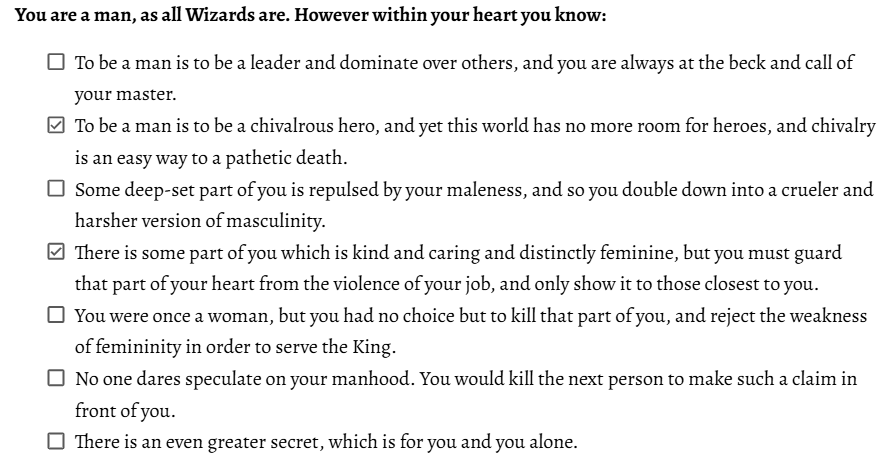 Image description: A section of the Warlock’s codex. It reads “you are a man, as all wizards are. However within your heart you know” before listing a series of options. The options “To be a man is to be a chivalrous hero, and yet this world has no more room for heroes, and chivalry is an easy way to a pathetic death” and “There is some part of you which is kind and caring and distinctly feminine, but you must guard that part from the harshness of your job, and only show it to those closest to you” have both been marked.
Much like in the real world, patriarchy is something that you can’t escape throughout Seven-Part Pact. It’s something that informs every interaction at every Wizardmoot, every conversation between your wizard and his wife, and every lesson he teaches to his prentice. The pronouns section of your character sheet actually comes pre-filled in with “he/him”, and if you want to defy the norms of the pact, by being a woman or something else, you need to defy the rules by crossing that out and writing something new. I decided I wanted to play my character, Nestor, as a transfeminine egg, stuck in a time period and a position where transitioning isn’t really an option or even something she’d be aware of; she dismissed her discomfort with masculinity as believing that it came from being unable to emulate the chivalrous heroes of ages past as the world has moved past that. It was never something we played out a conversation about (though admittedly I’d have loved to explore it more in a longer campaign), but it was something that was in the back of my head in every scene I played and the game was so much richer for it.
Ultimately Seven-Part Pact’s character creation works so well because rather than giving you a blank slate or letting you pick a vague class that’s justification for your bundle of abilities, it gives you a character. And while there are many different ways for you to shape that particular character and flesh them out, you’re given such a strong foundation to work from that it’s really easy to create a compelling character with a history and a life that you want to follow.
And then the session starts with the first meeting of the Pact, and you are very suddenly humbled by the realisation that everyone is the protagonist of their own five book fantasy saga.
Part 3: Wizards Are Mortal
Rather than having a single GM figure, Seven-Part Pact instead divides responsibility between each of the seven players as the Celestial Audience, with their specific Audience role tying into their wizard’s domain. So the Necromancer becomes the Watcher of the Gates, dealing with death and the repercussions thereof; the Mariner is Watcher of the Storms, considering the environment and the natural world; the Sage is the Watcher of the Stars, serving as a narrative meta-GM tying together plot threads from across the game. And as the Warlock I was also the Watcher of the Throne, which I’d describe as a sort of thematic GM, holding the other wizards accountable to the “truths” about wizardry and masculinity and considering the effects of power and violence within the game.
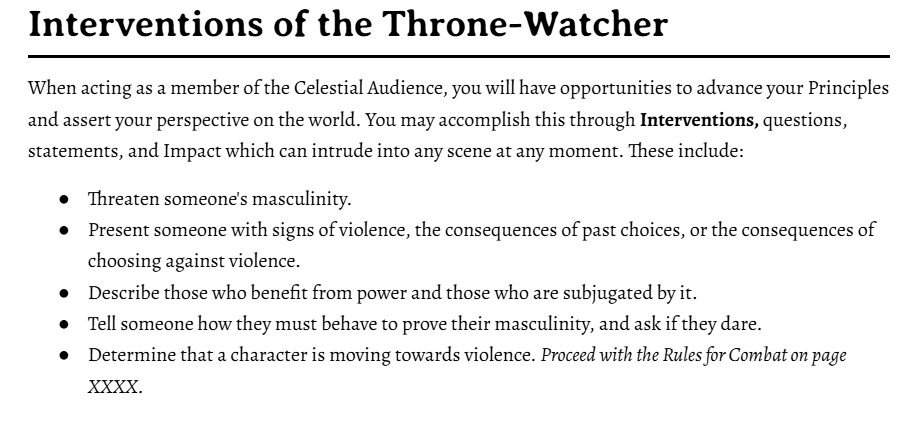 *Image description: The interventions of the Throne-Watcher, which include “Threaten someone’s masculinity”, “Describe those who benefit from power and those who are subjugated by it”, and “tell someone how they must behave to prove their masculinity, and ask if they dare”.
On one hand, this could make Seven-Part Pact hard to approach for a new player. To even just play the simplest wizard, there’s a lot of information to parse and a lot of mechanics to understand just about your domain. To prepare for this one shot alone, I read the entire 130 rulebook, my own 70 page codex, and the 170 page spellbook so that I could wrap my head around everything I needed.5 I can’t even imagine how hard it must be to teach if you have a group who prefer to learn by playing.
On the other hand though, I think that this distribution of responsibility in turn takes single-handed responsibility off any one player. Seven-Part Pact is so big and ornate that putting everything on one person would be overwhelming and unattainable, and by distributing this I think it’s able to make playing the game more feasible just on a logistical level. While you have aspects of the game that you need to learn, no one needs to learn everything, and it also means that each member of the Audience can focus completely on their aspect of GMIng, introducing ideas that they might not have been able to think of if they’d been working alone.
To provide an example, each wizard gets to pick some treasures during character creation, and one of the Warlock’s is a dragon egg. I decided that Nestor was going to try to hatch this dragon egg, which I successfully did. This triggered so many reactions from my fellow players (both in game and at the table) that I never would’ve thought of it I were the sole GM; the dragon became a monster on the Mariner’s board, who also decided that not only would it cost Nestor a lot of money to keep feeding the dragon but also that the presence of such a powerful creature would make the climate of the Halcyon Isles hotter; the Watcher of the Chains decided that power would seep from the crown and into Ergoism, the belief that the Wizards of the Pact should be the true rulers of Isha; the Watcher of the Flame decided that the presence to a dragon in Isha would make the common people panic. Having multiple GMs focused on different parts of the game makes the game and its world feel so interconnected.
As a note: this one shot was held online in a discord call, and I often struggle to concentrate during online games especially without webcams on. I did not struggle at all during our Seven-Part Pact one shot because, even though I wasn’t the sole GM, my GMing role meant that I had a much easier time concentrating because I had to be ready if my reactions as Watcher of the Throne were needed. It makes a game that can feel sprawling and disconnected very easy to stay invested in all the way through.
Part 4: Wizards Are Lonely
In her article Rules Are A Cage (And I’m A Puppygirl),6 Dragon discusses the nature of rules within a TTRPG. In contrast to other mediums like video games or board games, rules in a tabletop RPG tend to be restrictive rather than freeing. If you’re sitting around a table and telling a story with your friends, then your character can arguably do anything; the rules of a given TTRPG system introduce restrictions, and the fun comes from playing with the knowledge of those restrictions and from struggling against them. And you can definitely see the ways in which this design philosophy informs the rules of Seven-Part Pact.
A session of Seven-Part Pact will usually cover an in-game month, and each month every wizard gets four units of time to spend as they wish. They can spend these units of time in various ways, including casting spells, spending time with their companions, or attending the mandatory monthly Wizardmoot, but you’re most likely going to be spending it playing your own personal board game, which reflects your Wizard’s domain.
The Warlock’s board game, for example, simulates the court of Isha’s King: each month a certain number of Lord cards are drawn from each of the five noble Clans. Each Lord card has a different agenda that will affect the rest of the game in a different way, so the Royal Executioner might kill another Lord, or the Baron of the Graven Isle might lock down another Wizard’s game state. You can spend time distracting nobles to stop them from achieving their agenda, but this causes authority to leak from the King’s hands into rival ideologies, and as each ideology gains more power, it begins to change the fabric of Isha’s government.
These board games are, frankly, stressful, frustrating, and restrictive, but that then becomes the narrative. Your Wizard has this ticking time bomb in front of them that, if it falls apart, will cause the collapse of Isha (or of the Pact, which might be worse to some wizards), but you also have your own personal goals and relationships to care about. Will you focus wholeheartedly on your domain to the detriment of everything else? Will you half-ass it while trying to achieve your goals? Or will you say “fuck it” and let your domain go to hell so you can hatch a dragon egg?
This is also an area where Seven-Part Pact’s complexity really serves it well. You understand your own domain, but not necessarily everyone else’s, making it very easy to get in that arrogant wizardly headspace of “I am doing the most important job here”. Between this and the grand scale of the magic possible (one of the highest-level spells literally lets your character ascend to godhood), Seven-Part Pact is a game that lends itself very well to a type of cold war PVP as its seven ridiculously powerful wizards hate each other but can’t go into open war because of how thoroughly it’ll fuck everything up. It’s an absolutely wonderful state for a game of scheming, arrogant wizards to be in.
End: We Dream of Another World
Seven-Part Pact wrapped up its Kickstarter in August 2026, although late pledges are still available (https://www.kickstarter.com/projects/sjgames/seven-part-pact) and you can read the playtest drafts on Dragon’s patreon (https://www.patreon.com/c/possumcreek/home). I truly cannot wait until I can get my grubby little hands on a physical copy, because if Seven-Part Pact left me with this much to think about and this much to yap about after only a one shot? Who knows what a full campaign will do to me.
A detail I can’t really fit anywhere neatly but that I really love is that each wizard plays around in their own fantasy subgenre; the Necromancer could be from a Locked Tomb-esque necromantic dark fantasy, the Mariner could be from Earthsea-style adventure fantasy, the Sage is the most Merlin/Gandalf-esque wizard classic.↩
I’m also rather new to playing games online with strangers, so some anxiety also sprung from that source.↩
It was Let’s Make a Pact from the Misericorde soundtrack, if you’re curious: https://www.youtube.com/watch?v=vGteni1o_PA.↩
There should be a Slugblaster review coming next month, fingers crossed!↩
This was, admittedly, more than I needed to read for a one shot but I regularly read TTRPG rulebooks cover-to-cover for fun so I didn’t really mind.↩
Available here: https://possumcreek.medium.com/rules-are-a-cage-and-im-a-puppygirl-69e8d569b2b6. Dragon also has a series of very good articles about the development of Seven-Part Pact that I would highly recommend!↩