Slugblaster, the multiversal skateboarding TTRPG about growing up
Hillview is a small town with thin spacetime, where bored teenagers have developed a thriving local hobby: slipping into other dimensions on their hoverboards to do cool tricks, blow up online… and inevitably get chased by an interdimensional monster. Is it dangerous? You know it. Is it stupid? Of course. Is it freaking out church groups and interdimensional researchers and concerned parents alike? Absolutely. Does any of that matter? No. Slugblasting isn’t just a hobby; it’s a subculture, it’s a core part of every teenage slugblaster’s identity, and it’s a way to get away from the problems at home.

This is the premise of Mikey Hamm’s Slugblaster, and it might be my favourite premise for a TTRPG. I ran a twelve session campaign of it over the summer and it was a delightful time. It made me laugh more than maybe any other TTRPG campaign I’ve played, and at the same time its systems leant itself really well to personal drama as our crew, Two Girlz Kissing, dealt with shady megacorporate sponsors, unsupportive families, interdimensional vampires, and the many times your friend is a bit of a dick for no real reason.
Slugblaster’s premise works in so many ways. Everyone has been a teenager, so it’s really easy to get into your character's mindset and to bring your own experiences to the table. I was playing with an entirely transfemme group, so the struggles of being the only queer people in a small town and having slugblasting as a way to meet other queer people was ever-present subtext throughout our campaign. It’s a time of big emotions while also having characters who struggle to deal with those emotions in healthy ways, making it ripe for character drama, and its sci-fi elements are so much fun.
Slugblaster isn’t married to its default setting, even providing examples of alternate hometowns and dimensions you could use as a springboard for inventing your own, but at the same time the default setting is so fun and bizarre that it stands on its own excellently; the cyberpunk megadystopia dimension of Operaeblum and the hellish ruin-filled Dark Souls wasteland of the Waking Pits were two favourite dimensions, and the monsters that it provides are some of my favourites in any TTRPG. You might contend with a quantum centipede, a seemingly neverending giant insect that feeds on possible timelines of someone’s life, starting with the best possible one, or maybe a salvage crab, a giant hermit crab hiding inside an abandoned fighter jet with a still functioning missile system. Its factions are a lot of fun, ranging from other slugblasting crews to befriend or make enemies with, to a set of sponsors ranging from “indie assholes” to “incredibly sinister tech company”, to a concerned parents group who wants to ban slugblasting.
It’s brimming with so much imagination, and it can also cover a broad range of tones. I wanted to lean heavily into the teen sports drama and contrast that with the psychedelic multiverse chicanery, so I’d probably describe our tone as something like Butterfly Soup if instead of playing baseball they travelled to other dimensions and did kickflips, but there are enough plot hooks and monsters that you could definitely run it as more of a gonzo Saturday morning cartoon or even skew into pulpy horror.
“When I was pitched the premise of slugblaster, I was weary at first because it seemed too insane to have space for a grounded story, but I ended up playing a game that felt like a Cartoon Network show that would have totally changed my life as a kid.” - Megan, who played Tryck, the Chill.

Slugblaster uses a very stripped-down and remixed version of the Forged in the Dark system, originally from John Harper’s Blades in the Dark. Whenever you do something risky, roll a pool of d6s and take the highest result. On a six it’s a success, on a four or five it’s a success with a complication, and on a one, two, or three it’s a failure. Unlike other Forged in the Dark games though, Slugblaster has no skills or stats to make up your dice pools. Each character instead has a pool of Boost, which they can use to add a die to their pool, and Kick, which can increase the effectiveness of their result. Rather than making each run a case of choosing the approach that suits your character’s abilities, it’s a really effective game of resource management, with each dice roll balancing the benefits of using resources now in exchange for potentially missing them out when you need them. As a run continues, your resources dwindle and dwindle, making the risk-reward of when to use them a really compelling core gameplay hook. And if you ever feel like it you can say “check it!” to do a trick and add a d6 to the roll, at the cost of facing harsher consequences.
Rather than picking a class or playbook, character creation has players picking a Personality archetype for their character to fit into. The Guts is the incredibly confident one, to an almost obnoxious degree, so their abilities revolve around showing off or high-risk, high-reward plays; the Heart is the caring core of the group, so their abilities involve supporting their teammates and emotional intelligence; the Chill is… the chill one, so their abilities involve looking cool without realising it and stumbling into things no one else notices.
It also has you picking a Signature, a piece of gear unique to each slugblaster, and these are just so fun. Maybe you have a pair of trainers that let you phase through objects, or a set of 3D-printed power armour, or a sword that lets you slice through spacetime. Throw in the Slime, Warp & Solder expansion and you can get even more weird and esoteric, like psychic powers, a magical sword instead of a hoverboard, or Everything Everywhere All at Once-style ‘verse jumping. You can even find new components and use them to modify your gear, gaining new abilities… and admittedly the mod system isn’t one I really vibed with. Searching for components wasn’t really something we had time for in our very sports drama-leaning campaign, and as a GM I was mostly thinking of the other progression systems. The new system of training and breakthroughs introduced for some of the new signatures in Slime, Warp, & Solder fixes this issue though, using the same progression system as the other abilities.

Like Blades in the Dark, Slugblaster is divided between the run and the downtime between them. Runs are typically very player-led, picking a dimension they want to visit or a goal they want to achieve, and might see them travelling to another dimension to get a record run on a certain skating route, going to a party in a post-apocalyptic mall, taking part in a skate competition in a dimension best described as “Earth, but cooler”, or maybe just running away from homecoming and challenging your dickhead rivals to a game of SKATE. 1 But I think downtime is where Slugblaster presents my favourite mechanics.
During runs, the players will accrue Style for doing cool tricks and Trouble for avoiding consequences. They will then spend Style and Trouble on different ability unlocks during downtime, and each of these unlocks carries with it a scene that you then play out. If you want to unlock a new ability for your character, you might choose your Origin Story, then play out a key scene from your character's past that shaped them into the Slugblaster they are today. Where Slugblaster really innovates though is that some of these scenes can then link together into Arcs, some universal and some unique to each Personality.
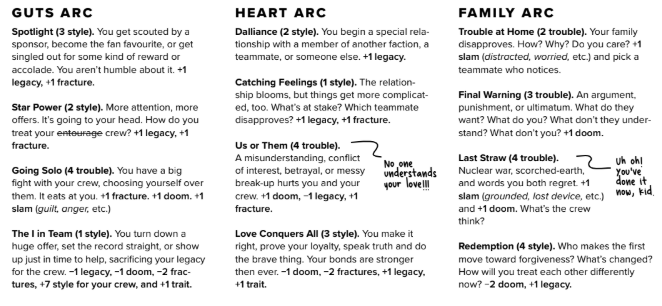 ID: The Guts, Heart, and Family Arcs.
I don’t speak for everyone but when I’m playing a storygame I feel like it’s really elevated by compelling character arcs, but at the same time it can be difficult for players to navigate giving their character within an improvised narrative. Like in Heart: The City Beneath, Slugblaster provides an incredibly easy structure to give your character a compelling arc, one explicitly tied to your character’s personality, and while the bones of the arc are the same they can be spun out into a variety of different ways. In my campaign our Guts was singled out by the crew’s sponsor and let it massively go to his head, our Heart started dating a girl who really wasn’t right for her (while completely oblivious to her close friend Lyyra’s crush on her), and our Chill had an especially heartwrenching Family Arc where his controlling and transphobic parents tried to stop him from slugblasting.
Admittedly not all of the Arcs are created equal; the Guts arc of trying to do something impossible is very similar to the Smarts Arc of… trying to invent impossible, but this is another issue fixed by Slime, Warp, & Solder, which adds an alternate Arc for each Personality. The old Smarts Arc was pretty forgettable in my opinion, but the new Arc from Warp of them being mentored by someone the rest of the team views as a bad influence is probably the one I’d most want to explore if I were a Slugblaster player.
“The setting is very rich, and the switching between runs and character beats made the game very balanced. While separated at first, toward the end of the game, the downtime sessions really informed the runs and led to shockingly emotional beats while we were slugblasting. I will never forget when our Guts peeled back,2 and my character initially didn’t feel a thing because he was desensitized by the hobby at that point. What an amazing moment.” - Megan
These Arcs are, in my opinion, the selling point of the game, even more so than the quantum centipedes and the interdimensional portals. Slugblaster is a game explicitly designed for short campaigns of maybe twenty sessions at most, and combined with these Arcs it makes it incredibly easy to play as not just a gonzo sci-fi adventure game but also as a coming of age drama. The crew go through something together, we see how they change and grow, and then they part ways.
"As a player in Slugblaster I particularly enjoyed systems like character arcs and just beats in general. I think when playing a character I often fall into playing TTRPGs in a far more "gamey" way than I'd like so being made to act out scenes and consider how they directly related to my character's growth really helped reign in that impulse and allow me to focus more fully on helping to create a story." - Mint, who played Pax, the Guts.
As a GM, I found Slugblaster really enjoyable and simple to run. While it took me a couple of sessions to get used to a game so different from everything I’ve run previously, by the second run it’d clicked into place. Downtime sessions are a breeze, with players setting up their own beat events that usually run themselves; I’d highly recommend the optional rule where family members are played by the PCs that aren’t in the scene, because it means that your players will offer really fun twists on a character you wouldn’t have thought of and that you have a scene partner to play off of. As an improv GM, the runs are great too; the game’s sandboxy nature lets the players pick what they want to do and the setting provides enough guidance while still having a lot of places to flesh them out.
And can I be honest for a second? After so many campaigns about the characters trying to solve their problems through violence, it was just really nice to be able to play a campaign where the characters never killed anyone and the only act of violence was punching a vampire while also jumping over a chasm on a hoverboard. If anything, Slugblaster is a game about fucking around and finding out, more about accidentally waking up a giant bug and running away from it than killing it to take its stuff.
After all that, Slugblaster is just excellent on a product level. The copywriting is a perfect blend of casual, fun, and informative and it’s enjoyable to read just as a book, the layout is clear, and the artwork is great. It’s colorful and lively and I especially love the way it’ll occasionally switch into in-universe sources like an advert or an anti-slugblasting PSA, it’s very fun and thematic.
I’ve mentioned Slime, Warp, & Solder a couple times and I think it’s a really great expansion. Beyond the systemic tweaks it makes that improved upon some of my issues, it’s also overloading with great new pieces of gear and some pretty gnarly monsters, including a god of death that feels like it fell out of a different TTRPG but also perfectly fits into Slugblaster.
The pdf is $15 on itch.io or you can grab the physical from Mythworks for £33, and you can get Slime, Warp & Solder as a bundle on itch for $20.3 It’s a delightful game and I can’t recommend it enough. Thank you to Megan and Mint, two of my wonderful players, for contributing some of their thoughts. You can find Megan on instagram as @meggitz.comics.
These are all runs that happened in my campaign.↩
“Peelback” is the in-universe term for when your atoms reject the universe you’re currently in and kicks you back to your home dimension. It often comes with the risk of injury or even more esoteric things, like strange physical transformations, amnesia, or the threat of being followed by an interdimensional beastie.↩
Core book pdf: https://wilkies.itch.io/slugblaster Core book physical: https://www.myth.works/en-gb/products/slugblaster Slime, Warp, & Solder bundle: https://itch.io/s/186203/slime-warp-solder↩